
The promise has been repeated so often it risks becoming background noise: artificial intelligence will transform NHS diagnostics, catch cancers earlier, cut waiting lists, and free up clinicians to focus on what humans do best. Some of that is already happening. Some of it remains, at best, a well-funded aspiration. Getting an honest picture requires looking past the press releases and into the actual deployment data, trial results, and independent evaluations that have emerged over the past two to three years.

Where AI diagnostic tools in the NHS are genuinely being used
The clearest real-world deployment sits in radiology. NHS England’s AI and Digital Transformation programme has funded over 86 AI imaging tools through its Accelerating AI in Imaging initiative, and a significant number of these are now in routine clinical use across NHS trusts. The most mature application is chest X-ray triage. Tools like Annalise.ai and Behold.ai analyse chest radiographs and flag potential abnormalities, prioritising urgent cases in radiologist worklists. At University Hospitals of Leicester NHS Trust, a 2023 evaluation found that AI triage reduced the median time to report urgent chest X-rays by around 11 days. That is not a marginal gain.
Mammography screening is another area where the evidence is solidifying. A large UK trial published in The Lancet Oncology in 2023 found that AI could safely act as a second reader in breast cancer screening, matching the performance of a human radiologist. The NHS breast screening programme, which handles millions of mammograms annually, is now piloting AI double-reading in several trusts, potentially freeing up radiologist time at a moment when the workforce is under severe pressure. NHS England’s own 2025 report on AI in imaging cited projected capacity gains of up to 30% in some radiology departments where these tools have been integrated properly.
Pathology and the harder problem of deployment at scale
Pathology is where the technology is promising but the implementation story is messier. Computational pathology, which uses AI to analyse digitised tissue slides, has shown genuine clinical value in research settings. Paige.ai, for instance, received regulatory clearance in the UK for prostate cancer detection on digital slides. Studies have shown AI can identify clinically significant prostate cancer with sensitivity comparable to experienced pathologists, and in some cases catching cases that were initially missed.
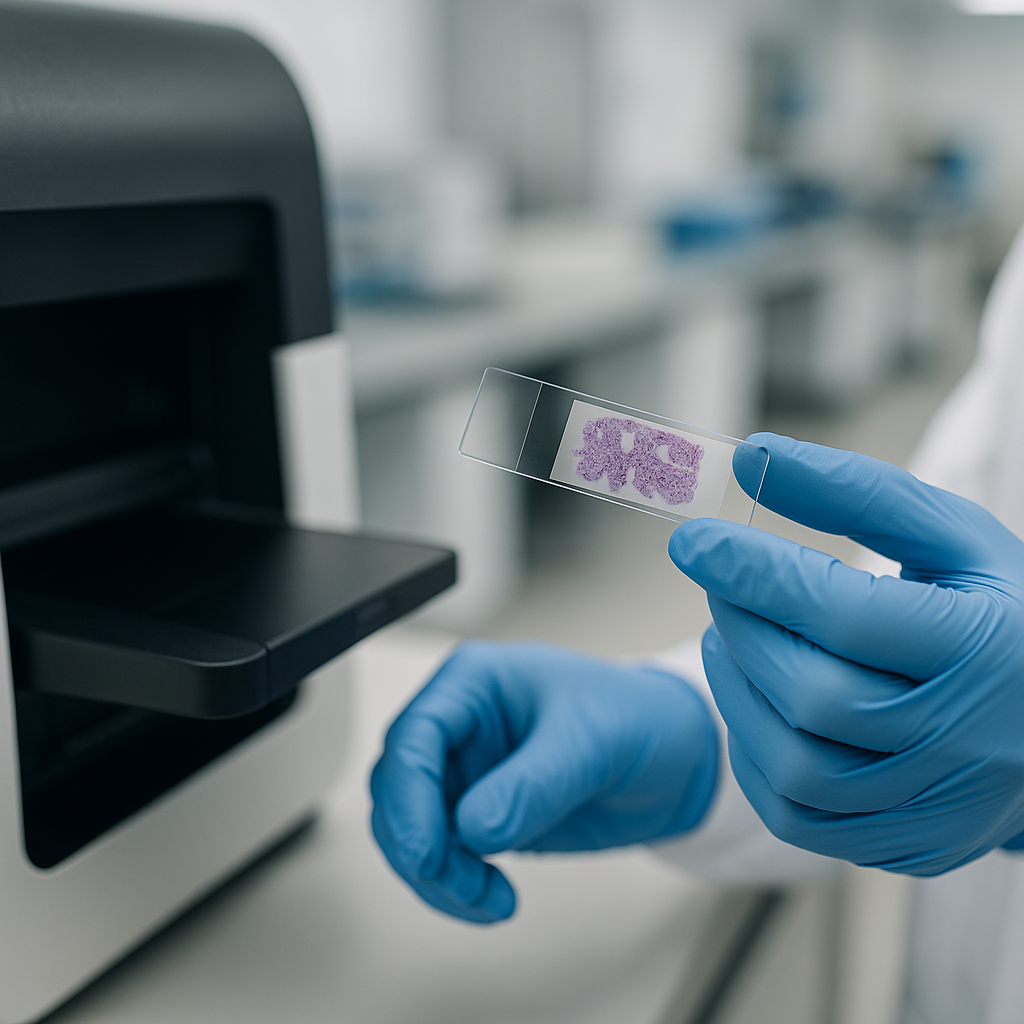
The problem is infrastructure. The majority of NHS pathology labs are not yet fully digitised. Whole slide imaging requires significant investment in scanners, storage, and connectivity, and many trusts are still in transition. NHS England’s National Pathology Programme has set targets for full digital pathology rollout, but as of early 2026, adoption remains uneven across the country. Without digitisation, AI pathology tools simply cannot run. The gap between what the technology can do in a well-resourced trial setting and what it can do in the average NHS lab is still wide, and it is mainly a structural problem rather than a clinical one.
What the independent evaluations actually say
The National Institute for Health and Care Excellence (NICE) has been publishing evidence reviews on AI medical devices through its Early Value Assessment programme. These assessments are worth reading carefully because they are specifically designed to distinguish between devices that have robust evidence and those that have been deployed on the basis of theoretical benefit. Several AI diagnostic tools that entered NHS use with considerable fanfare have received NICE guidance noting that the evidence base remains limited or that further real-world data is needed before confident recommendations can be made.
The Topol Review, conducted by Dr Eric Topol and published by Health Education England, laid out a credible framework for AI in clinical practice, but it was also honest that workforce preparation, data governance, and integration with existing electronic health record systems were the real bottlenecks, not the algorithms themselves. That observation has aged well. A 2025 review by the Health Foundation found that NHS trusts frequently struggled to integrate AI tools with their existing IT infrastructure, and that time spent on implementation and staff training often exceeded original projections considerably.
For context, the NHS’s broader digital maturity varies dramatically by trust. A foundation trust in London with mature electronic patient records and a strong informatics team is in a very different position from a district general hospital still reliant on paper-based processes in some departments. AI diagnostic tools tend to perform best where digital foundations are already solid, which means the hospitals that arguably need capacity relief the most are often the least equipped to benefit quickly.
The clinical safety and bias questions that still need answering
One area that deserves more public attention is algorithmic bias. Most AI diagnostic tools were trained on datasets that over-represent certain demographic groups, and there is credible evidence that performance can differ across ethnicities, age groups, and body types. NHS England’s AI and Digital Transformation team has acknowledged this in its guidance and requires suppliers to provide disaggregated performance data. Whether trusts are consistently demanding and reviewing that data in practice is a different question.
The Medicines and Healthcare products Regulatory Agency (MHRA) regulates AI diagnostic devices as software medical devices in the UK, and its evolving guidance framework is genuinely trying to keep pace with the technology. But post-market surveillance of AI tools, tracking how they perform once deployed in real NHS conditions rather than controlled trials, remains an underdeveloped area. A tool that performs well in a trial with carefully curated data may behave differently when processing the full messy complexity of real clinical practice. The NICE evidence reviews on AI and digital tools provide a useful starting point for anyone wanting to assess specific devices critically.
The honest picture in 2026
AI diagnostic tools in the NHS are not a fantasy. In radiology, particularly chest X-ray triage and mammography, there are real deployments with real evidence of clinical benefit. Pathology is following, more slowly, constrained by infrastructure rather than technology. The honest picture is one of genuine but uneven progress, with pockets of meaningful impact sitting alongside a much larger landscape of tools that are approved, funded, or trialled but not yet meaningfully integrated into routine care.
The workforce question matters enormously here. AI tools are most useful when clinicians trust them enough to act on their outputs, which requires training, familiarity, and time, all things the NHS is chronically short of. There is also a governance dimension that does not get enough attention: ensuring that patient data used to train and run these systems is handled appropriately, that consent is meaningful, and that the commercial interests of AI vendors do not distort clinical decision-making. These are not reasons to be pessimistic about the technology. They are the actual work that needs to happen alongside it.
On a lighter administrative note, if you work in NHS communications or health tech and you are sending bulk email updates about AI programmes and digital health initiatives, it is worth ensuring your messages actually reach inboxes. A free spam checker can quickly identify whether your outgoing emails are likely to be filtered before they reach clinicians or commissioners who need to see them.
The technology is capable of making a genuine difference to diagnostic capacity and patient outcomes in the NHS. The evidence from the strongest deployments makes that clear. What is equally clear is that the gap between potential and consistent, equitable, system-wide benefit is still significant, and closing it is largely a leadership, infrastructure, and workforce challenge rather than an algorithmic one.
Frequently Asked Questions
Which AI diagnostic tools are currently approved for use in the NHS?
A number of AI imaging tools are in active NHS use, including tools for chest X-ray triage, mammography second-reading, and diabetic eye screening. NICE’s Early Value Assessments and NHS England’s AI imaging programme list approved and piloted devices, though availability varies considerably by trust and region.
Is AI replacing NHS radiologists and pathologists?
No. Current AI diagnostic tools act as decision-support systems, flagging cases for review and prioritising worklists rather than making final clinical decisions. The intent is to support and extend the capacity of clinical staff, not to replace human judgement, particularly given ongoing NHS workforce shortages.
How accurate are AI diagnostic tools compared to human clinicians?
In specific, well-studied tasks such as mammography reading and chest X-ray triage, some AI tools have demonstrated performance comparable to experienced clinicians in controlled trials. However, real-world performance can differ from trial performance depending on data quality, patient demographics, and local implementation, so independent evaluation is important.
Are there concerns about bias in NHS AI diagnostic systems?
Yes, and this is an active area of scrutiny. Many AI tools were trained on datasets that do not fully represent the diversity of the UK population, which can lead to reduced accuracy for certain ethnic groups or demographic subsets. NHS England requires suppliers to provide disaggregated performance data, but monitoring in routine deployment remains inconsistent.
Who regulates AI diagnostic devices used in the NHS?
The MHRA (Medicines and Healthcare products Regulatory Agency) regulates AI diagnostic tools as software medical devices in the UK. NICE also provides clinical guidance and evidence assessments through its Early Value Assessment programme, which helps NHS trusts evaluate whether specific tools have sufficient evidence to justify adoption.
Leave a Reply